

Atomic Orbital VR (2021)
Description
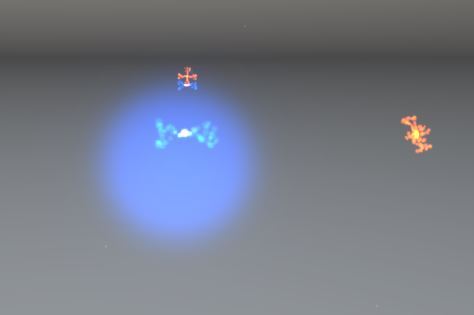
Atomic Orbital VR, released in 2021, places players inside the structure of an atom, where the main task is to maintain balance between electrons and protons. The game introduces a virtual reality environment that transforms abstract atomic concepts into an interactive experience. Players are positioned at the center of an atom and must actively manage the movement of charged particles to restore the atom’s net charge to a neutral state.
Gameplay Mechanics
The core gameplay involves controlling both positive and negative charges using virtual hands. Incoming protons and electrons approach the player, and it is the player’s responsibility to deflect these particles in specific directions toward six static protons and electrons that orbit around the player. By accurately directing these particles, the net charge of the atom can be corrected, stabilizing its structure.
Another important element of gameplay is stage management. Players can push the six stationary protons and electrons away from themselves in order to clear the level, allowing for a more strategic approach in managing the atomic environment. This combination of deflection and positioning introduces a layer of challenge, requiring attention, timing, and precision in order to succeed.
Controls and Interaction
Players utilize two virtual hands within the VR environment: one representing positive charge, the other negative. These hands allow the user to manipulate incoming atomic particles dynamically. By directing protons and electrons toward specific stationary charges, the player maintains equilibrium within the atom. This mechanic mirrors the physical principles of attraction and repulsion that govern charged particles in real atomic systems.
Scientific Basis and Inspiration
The design of Atomic Orbital VR draws heavily on concepts from chemistry and quantum mechanics. Specifically, the game is inspired by the notion of atomic orbitals, which are mathematical functions describing the position and wave-like behavior of electrons within an atom. These orbitals predict the likelihood of locating an electron in a given region around the nucleus. In the game, the six static protons and electrons represent these regions, providing players with a tangible method of visualizing electron probability distributions.
The term “atomic orbital” in physics refers both to the mathematical function and the physical space where electrons are likely to be found. By translating this into VR gameplay, the developers provide a practical representation of otherwise abstract atomic principles, allowing users to engage with quantum concepts through direct interaction.
Objectives and Challenges
The primary goal of the game is to maintain the atom’s neutrality by managing the flow and interaction of subatomic particles. Players face incoming electrons and protons that must be carefully deflected toward the correct static charges. Failure to do so results in imbalance, demonstrating the consequences of unbalanced atomic structures. Additionally, clearing the stage by moving static charges away introduces a layer of spatial management and strategy.
Educational and Interactive Value
While entertaining, Atomic Orbital VR also serves as an educational tool, allowing players to experience the dynamics of atomic particles firsthand. The interactive mechanics encourage an understanding of charge interactions, electron probability, and atomic structure. This combination of gameplay and educational content provides a unique platform for learning, bridging the gap between theoretical chemistry and experiential understanding.
Conclusion
In summary, Atomic Orbital VR delivers an immersive experience inside an atom, combining precise particle management, strategic positioning, and educational insight into atomic behavior. By controlling positive and negative virtual hands to guide electrons and protons, players actively restore neutrality within the atomic environment. Drawing inspiration from atomic theory and quantum mechanics, the game effectively transforms scientific principles into an interactive VR experience that is both challenging and instructive.