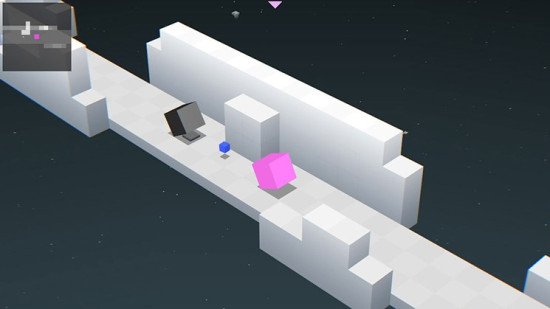
Edge is a distinctive isometric puzzle platformer that places players in control of a cube navigating complex, multi-level environments. The primary objective in each stage is to guide the cube to its designated goal while gathering luminous prisms scattered throughout the level, all while carefully avoiding the edges of the platform to prevent falling. The game employs an isometric perspective, presenting the environment at an angled, three-dimensional viewpoint that allows players to judge depth and distance as the cube moves diagonally across the grid-like surfaces.
Gameplay Mechanics
The core mechanic of Edge revolves around precise movement and balance. The cube can tilt and balance at specific angles, a feature that is crucial for navigating the most challenging sections of each stage. This balancing ability enables players to traverse narrow pathways, bridge gaps, and maintain stability on precarious surfaces. In addition to basic rolling, the cube can interact with moving blocks to climb over obstacles or execute advanced maneuvers, which are essential for mastering the most intricate levels. While these actions are mechanically straightforward, executing them with accuracy requires timing and skill.
Level Design and Challenges
The game features a total of 45 main levels, along with 3 additional unlockable stages. Each level is designed to test a combination of reflexes and spatial awareness rather than complex puzzle-solving alone. Hints within the environment generally indicate the path forward, ensuring players know where to move, yet the execution of these moves safely remains challenging. Collecting all the light prisms adds an extra layer of difficulty, as some are positioned in less obvious or hidden areas, demanding careful exploration and dexterity.
Visual Style
Edge utilizes a minimalistic polygonal art style, emphasizing clarity and focus. The geometric simplicity of the environments ensures that players’ attention is concentrated solely on navigation and movement strategy. There are no extraneous visual elements to distract from the gameplay, making each level a clean, structured test of skill and precision. The combination of this streamlined aesthetic with responsive controls enhances the sense of control and immersion, providing a visually coherent experience that complements the challenging mechanics.
Player Experience
Players of Edge engage in a constant interplay between speed and accuracy. Reflexes are tested as much as strategic planning, particularly in moments that require rapid adjustments to the cube’s trajectory or balance. The game’s design encourages learning through repetition, with each failed attempt offering insight into the timing and movement necessary to successfully navigate complex sequences. The reward system of prism collection adds motivation for thorough exploration, ensuring players not only reach the goal but also master the subtleties of each level’s layout.
Summary
In essence, Edge provides a focused, precision-driven puzzle platforming experience. Its isometric view, combined with the cube’s unique balancing mechanics, creates a gameplay environment where both skillful execution and careful observation are essential. The 45 main levels and additional unlockable stages offer a variety of challenges, from straightforward navigation to intricate sequences requiring advanced maneuvering. With a clean polygonal style and consistent emphasis on movement mastery, the game delivers a unique combination of reflex-based challenge and spatial problem-solving that defines its distinctive approach to puzzle platforming.
Our Verdict
Edge is a clean and challenging puzzle platformer that keeps you on your toes. Controlling the cube is simple to understand, but mastering the balance and tricky maneuvers takes real skill. The levels are smartly designed, with just enough challenge to make each success feel rewarding.
The graphics are minimal and clear, so you can focus entirely on the gameplay. While it leans more on reflexes than complex puzzles, it never feels unfair. Collecting all the prisms adds extra depth for those who want a full completion.
Overall, Edge is worth your time if you enjoy precise controls and steady challenges. It’s easy to pick up, hard to master, and leaves a satisfying sense of accomplishment with each level cleared. We recommend it.
FAQ
Edge is an isometric puzzle platformer where you control a cube and guide it through levels to reach the goal while collecting light prisms.
You move a cube through isometric levels, rolling and balancing it carefully to avoid falling off edges while collecting all prisms.
Yes, Edge can be challenging. It focuses more on precise movement and reflexes than complex puzzles, especially in later levels.
The game includes 45 main levels and a few additional unlockable levels.
Edge is available on multiple platforms including PC, macOS, Linux, iOS, Android, PlayStation, Nintendo systems, and PSP.
Yes, Edge has partial controller support depending on the platform.
Yes, the game includes Steam achievements and leaderboards on supported platforms.
Edge uses a simple, clean geometric and polygonal style that keeps the focus on gameplay and movement.
Edge has minimal story elements and focuses mainly on gameplay, movement, and level completion.