

Slay (2009)

Genres: StrategyBoard Games
Tags:
Singleplayer
| PC |
Released: 2016-11-30Requirements
|
||||||||||||||||
| iOS |
Released: 2009-02-27Requirements
|
||||||||||||||||
| Android |
Released: 2009-02-27Requirements
|
||||||||||||||||
Description
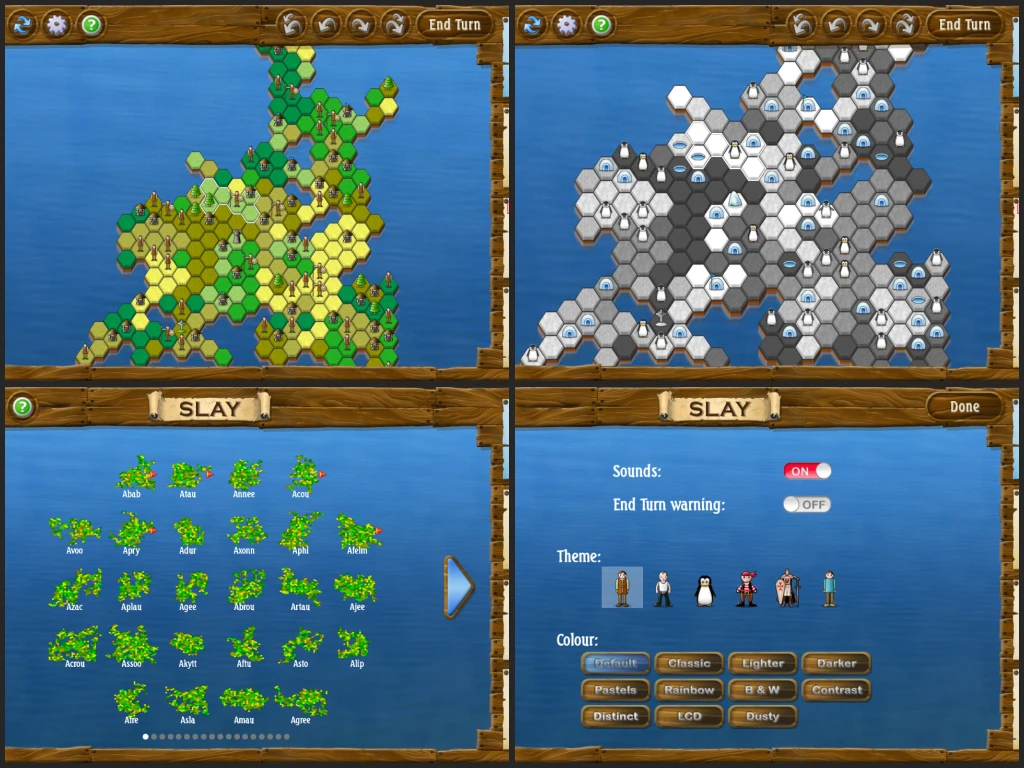
Slay is a strategic game based on turn-based mechanics where the main objective is to take control of the island by purchasing units and using them to capture the hexagonal territories held by opponents. Players must carefully plan each move to ensure they expand their influence while maintaining a balanced economy.
Gameplay Mechanics
The core gameplay revolves around acquiring men, who serve as the primary units for capturing enemy hexagons. A unique feature of the game allows players to combine two units into a single, more powerful unit. These stronger units are capable of defeating weaker enemy men, making strategic combination a key element for success. However, the increased strength comes with a higher maintenance cost, which requires players to manage their resources carefully.
Strategic Considerations
One of the central challenges in Slay is resource management. Since units cannot be sold back once purchased, players must strike a careful balance between strengthening their forces and avoiding overextension. Over-investing in powerful units can lead to financial strain, while underdeveloping leaves the player vulnerable to enemy attacks.
Another vital strategic aspect is the ability to split enemy territories effectively. By dividing an opponent's area, players can create situations where enemy territories become financially unsustainable. This tactic requires precision and foresight, as miscalculations can leave the player exposed while offering minimal advantage.
Unit Dynamics
The combination of two weaker men into a single stronger man introduces a layer of tactical depth. Stronger units dominate weaker ones in combat, yet they incur higher upkeep costs. This dynamic forces players to make critical decisions about whether to maintain a larger number of basic units or consolidate forces into fewer, more powerful men. Successful gameplay hinges on understanding the interplay between unit strength, maintenance cost, and territorial control.
Winning the Game
Victory in Slay is achieved through careful planning and calculated aggression. Players must continuously assess the value of each territory, the strength of their units, and the potential vulnerabilities of their opponents. Efficiently managing resources while strategically capturing and splitting territories forms the foundation of winning strategies. Every decision, from the timing of unit creation to the choice of target territories, impacts the player’s ability to dominate the island.
Conclusion
Slay (2009) offers a compact but deep turn-based strategy experience, emphasizing careful resource management, tactical unit combination, and strategic territorial conquest. Its mechanics reward players who plan ahead, balance risks, and exploit enemy weaknesses with precision. The game’s challenge lies not only in combat but in mastering the economics of unit maintenance and the tactical opportunities presented by territory division.
Our Verdict
Slay (2009) is a clever and challenging turn-based strategy game that keeps you thinking every move. Its simple rules hide a lot of depth, making each decision feel meaningful. You need to plan carefully, balance