

Confrontation (2012)
Genres: ActionRPGStrategy
Tags:
SingleplayerSteam AchievementsMultiplayerSteam CloudRPGFantasy
| PC |
Released: 2012-04-04Requirements |
Description
Introduction
Confrontation (2012) is a tactical role-playing game and the official video game adaptation of the tabletop game series created by Rackham. This title represents the sole entry in its intellectual property and was developed by Cyanide, a studio also recognized for its work on the Pro Cycling Manager series. The game translates the strategic elements of the tabletop original into a digital format, offering a structured experience centered on team-based tactical combat.
Plot
The storyline in Confrontation (2012) is delivered through concise mission briefings provided to the player before each task. The narrative is strictly linear, with events unfolding in a fixed sequence without deviation. The central theme revolves around the continuous confrontations faced by the protagonist team, although the game does not supply explicit motivations for their actions. Throughout gameplay, most of the playable characters remain silent, contributing to a minimalistic narrative presentation focused entirely on the tactical elements of the missions.
Gameplay
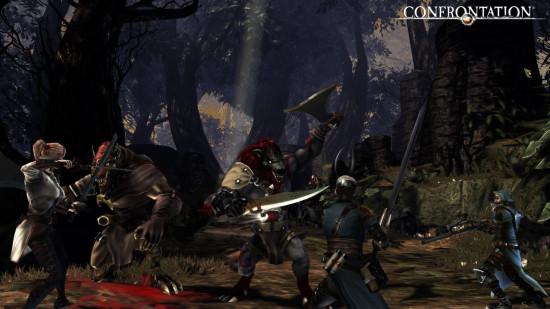
The game directly adapts the tabletop wargame mechanics and storylines into a video game format. Set in the medieval fantasy world of Aarklash, the environment is populated by familiar fantasy archetypes such as wizards, knights, and priests. The game presents multiple potential outcomes, but it does not clarify which faction ultimately succeeds, leaving the focus on tactical engagement rather than story resolution.
Players assemble a team of four characters from a selectable roster, creating a squad that must navigate through each level. The gameplay emphasizes strategic movement, positioning, and cooperation between team members to overcome enemies, traps, and environmental hazards. Confrontation does not include complex narrative interactions with NPCs, nor does it rely on intricate puzzle-solving; game challenges are primarily mechanical, often following simple patterns such as activating levers to open doors or clear obstacles. Each mission is designed to test tactical decision-making, requiring players to manage team resources and abilities effectively to progress through the stages.
World and Setting
The game’s universe, Aarklash, maintains continuity with the tabletop version. It is depicted as a highly stylized medieval setting with distinct factions that engage in ongoing conflicts. While the world features recognizable fantasy elements, the gameplay remains centered on tactical confrontations and team management rather than exploration or narrative development. Each level reinforces the strategic requirements of positioning, skill usage, and coordinated attacks, reflecting the origins of the game in tactical miniature combat.
Character Mechanics
In Confrontation (2012), the player controls four heroes whose abilities and roles must be carefully balanced to succeed in each mission. The absence of dialogue-heavy interactions shifts the gameplay focus entirely toward strategy, requiring precise planning for offensive and defensive actions. The characters are designed to complement each other, with players needing to account for synergy between different skills and abilities. This team-based approach ensures that each encounter demands thoughtful deployment and coordinated execution to advance successfully through the linear mission structure.
Conclusion
The adaptation of the Confrontation tabletop game into a video game format preserves the original's strategic combat focus while presenting it in a linear, mission-based structure. The game emphasizes tactical decision-making, team management, and navigating hazardous environments without relying on extensive storytelling or complex puzzles. Confrontation (2012) delivers a concise and mechanically driven experience for players interested in strategy-focused gameplay within a stylized medieval fantasy world.